
 Audio
Audio Development Board
 Electronic Components
 LED LIGHT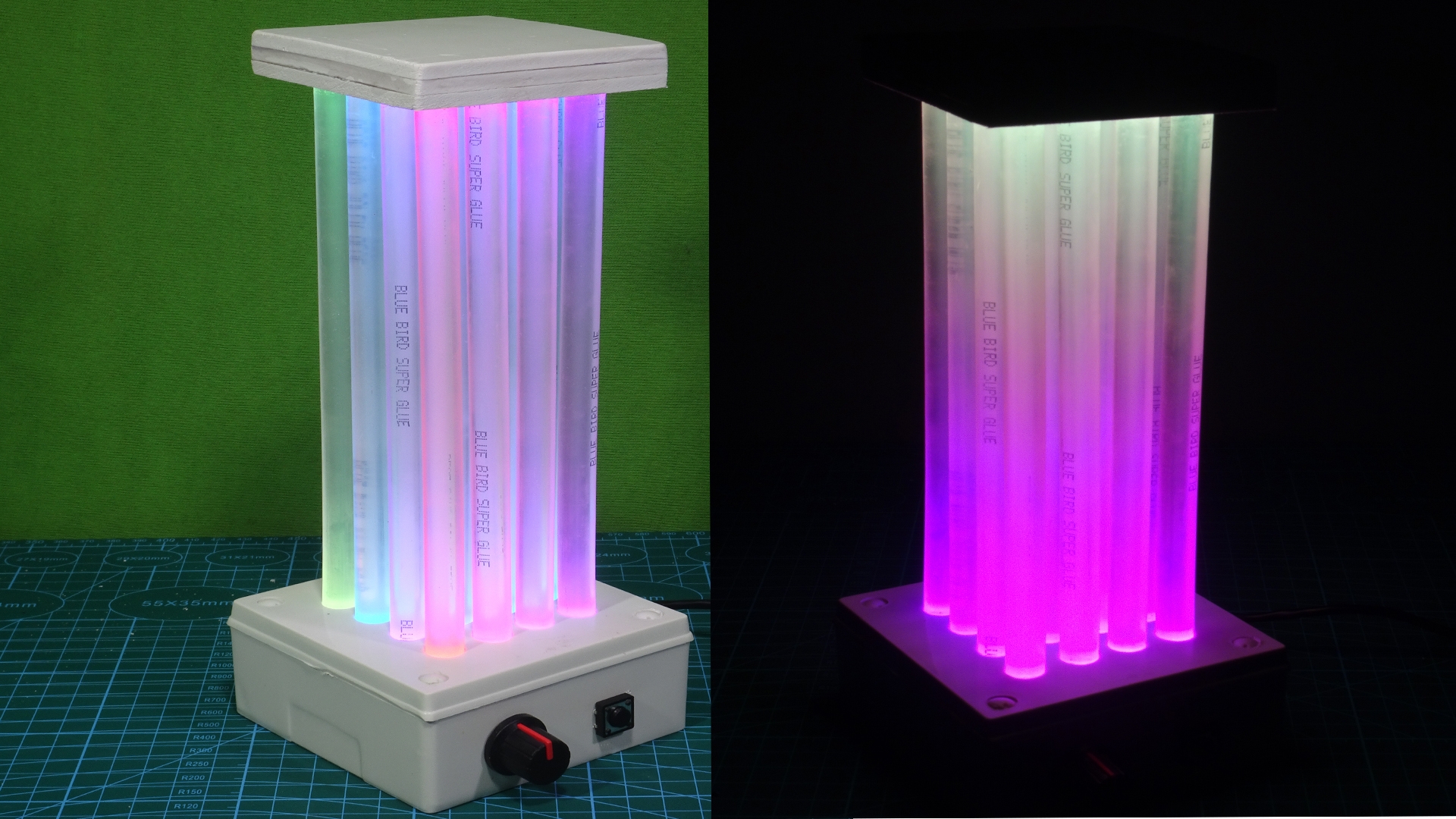
Amazing Light Effect Using RGB Light and Glue Stick
An interesting light display using 16 glue sticks and 32 WS2812B RGB LED strips.This lamp was based on a similar lamp called Hot Glue LED Matrix Lamp. the goal was to replace the 12mm Diffused Digital RGB LED used in jbumstead’s design with cheap WS2812B RGB strips and to make the container for the LEDs.
Components List:
- WS2812B LED Strip: https://amzn.to/3j0Tbv5
- Glue Sticks : https://amzn.to/35Z1XoB
- Plastic Box : You will get from local electronics shop
- 10K Pot : https://amzn.to/2TIAGke
- Mini Push Switch : https://amzn.to/34NklkC
- Arduino Nano : https://amzn.to/35Z2rep
- SPST Switch : https://amzn.to/3ef0kqu
Connection Diagram :
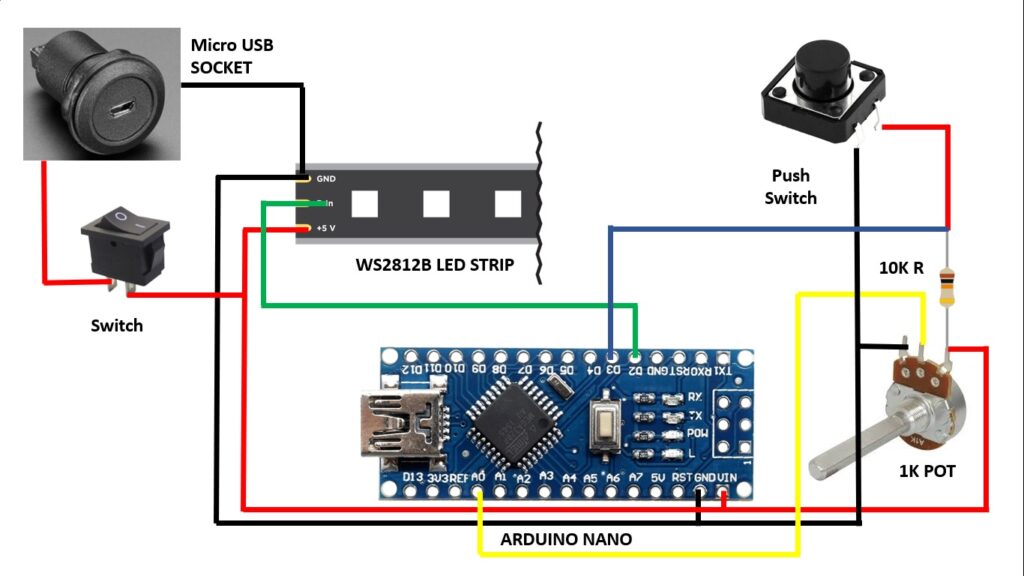
Code:
Main Page:
#include <Adafruit_NeoPixel.h>
#ifdef __AVR__
  #include <avr/power.h>
#endif

#include "Button.h"

#define PIN_LED 2
#define PIN_SWITCH 3
#define PIN_POT A0

#define LEDS 32

// Parameter 1 = number of pixels in strip
// Parameter 2 = Arduino pin number (most are valid)
// Parameter 3 = pixel type flags, add together as needed:
//   NEO_KHZ800  800 KHz bitstream (most NeoPixel products w/WS2812 LEDs)
//   NEO_KHZ400  400 KHz (classic 'v1' (not v2) FLORA pixels, WS2811 drivers)
//   NEO_GRB     Pixels are wired for GRB bitstream (most NeoPixel products)
//   NEO_RGB     Pixels are wired for RGB bitstream (v1 FLORA pixels, not v2)
//   NEO_RGBW    Pixels are wired for RGBW bitstream (NeoPixel RGBW products)
Adafruit_NeoPixel strip = Adafruit_NeoPixel(LEDS, PIN_LED, NEO_GRB + NEO_KHZ800);
Button mode = Button(PIN_SWITCH);
bool modePressed = false;

//Physical LED map for bottom and top LED arrays

const uint8_t botLED[] PROGMEM = {
  16,9,8,1,
  15,10,7,2,
  14,11,6,3,
  13,12,5,4,

};

const uint8_t topLED[] PROGMEM = {
  17,24,25,32,
  18,23,26,31,
  19,22,27,30,
  20,21,28,29,
};

//Storage for current values
int red = 128;
int green = 128;
int blue = 128;
int pattern = 1;

// IMPORTANT: To reduce NeoPixel burnout risk, add 1000 uF capacitor across
// pixel power leads, add 300 - 500 Ohm resistor on first pixel's data input
// and minimize distance between Arduino and first pixel.  Avoid connecting
// on a live circuit...if you must, connect GND first.

void setup()
{
  Serial.begin(115200);

  pinMode(PIN_LED, OUTPUT);
  pinMode(PIN_SWITCH, INPUT);
  pinMode(PIN_POT, INPUT);

  //Pixel Strip
  Serial.println("Setup()");
  strip.begin();
  strip.show(); // Initialize all pixels to 'off'

  //Button callbacks
  //mode.Background(ButtonBackground);

  //Set ISR for pin change on MODE pin
  Button::PinChangeSetup(PIN_SWITCH);
}

void loop()
{
  if (modePressed)
  {
    pattern = (pattern % 8) + 1;
    strip.clear();
  }
  modePressed = false;
  Serial.print("Mode ");
  Serial.print(pattern, DEC);
  Serial.println();
  switch (pattern)
  {
    case 1: colorWipe(strip.Color(255, 0, 0)); break; // Red
    case 2: colorWipe(strip.Color(0, 255, 0)); break; // Green
    case 3: colorWipe(strip.Color(0, 0, 255)); break; // Blue
    case 4: theaterChase(strip.Color(127, 127, 127)); break; // White
    case 5: rainbow(); break;
    case 6: rainbowDifference(); break;
    case 7: rainbowCycle(); break;
    case 8: rainbowCycleDifference(); break;
    case 9: theaterChaseRainbow(); break;
  }
  if (!modePressed)
  {
    modePressed = mode.Pressed();
  }
}

//Mode button interrupt to break out of loops etc
//PCINT1 handles pin changes for pins for A0 to A5
ISR (PCINT2_vect)
{
  modePressed = modePressed | (mode.State() == LOW);
}

void ButtonBackground(void)
{
}

// Fill the dots one after the other with a color
void colorWipe(uint32_t c)
{
  int total = strip.numPixels() / 2;
  for(uint16_t i=0; i < total && !modePressed; i++)
  {
    uint8_t botIndex = pgm_read_byte(&botLED[i]) - 1;
    strip.setPixelColor(botIndex, c);
    uint8_t topIndex = pgm_read_byte(&topLED[i]) - 1;
    strip.setPixelColor(topIndex, c);
    strip.show();
    delay(map(analogRead(PIN_POT), 0, 1024, 100, 0));
  }
  for(uint16_t i=total; i > 0 && !modePressed; i--)
  {
    uint8_t botIndex = pgm_read_byte(&botLED[i]) - 1;
    strip.setPixelColor(botIndex, 0);
    uint8_t topIndex = pgm_read_byte(&topLED[i]) - 1;
    strip.setPixelColor(topIndex, 0);
    strip.show();
    delay(map(analogRead(PIN_POT), 0, 1024, 100, 0));
  }
}

void rainbow()
{
  int total = strip.numPixels() / 2;
  for(uint16_t j=0; j < 256 && !modePressed; j++)
  {
    for(uint16_t i=0; i < total && !modePressed; i++)
    {
      uint32_t c = Wheel((i+j) & 255);
      uint8_t botIndex = pgm_read_byte(&botLED[i]) - 1;
      strip.setPixelColor(botIndex, c);
      uint8_t topIndex = pgm_read_byte(&topLED[i]) - 1;
      strip.setPixelColor(topIndex, c);
    }
    strip.show();
    delay(map(analogRead(PIN_POT), 0, 1024, 40, 0));
  }
}

void rainbowDifference()
{
  int total = strip.numPixels() / 2;
  for(uint16_t j=0; j < 256 && !modePressed; j++)
  {
    for(uint16_t i=0; i < total && !modePressed; i++)
    {
      uint32_t c = Wheel((i+j) & 255);
      uint8_t botIndex = pgm_read_byte(&botLED[i]) - 1;
      strip.setPixelColor(botIndex, c);
      c = Wheel((i+j+64) & 255);
      uint8_t topIndex = pgm_read_byte(&topLED[i]) - 1;
      strip.setPixelColor(topIndex, c);
    }
    strip.show();
    delay(map(analogRead(PIN_POT), 0, 1024, 40, 0));
  }
}

// Slightly different, this makes the rainbow equally distributed throughout
void rainbowCycle()
{
  int total = strip.numPixels() / 2;
  for(uint16_t j=0; j < 256*5 && !modePressed; j++)
  { // 5 cycles of all colors on wheel
    for(uint16_t i=0; i < total && !modePressed; i++)
    {
      uint32_t c = Wheel(((i * 256 / total) + j) & 255);
      uint8_t botIndex = pgm_read_byte(&botLED[i]) - 1;
      strip.setPixelColor(botIndex, c);
      uint8_t topIndex = pgm_read_byte(&topLED[i]) - 1;
      strip.setPixelColor(topIndex, c);
    }
    strip.show();
    delay(map(analogRead(PIN_POT), 0, 1024, 40, 0));
  }
}

// Slightly different, this makes the rainbow equally distributed throughout
void rainbowCycleDifference()
{
  int total = strip.numPixels() / 2;
  for(uint16_t j=0; j < 256*5 && !modePressed; j++)
  { // 5 cycles of all colors on wheel
    for(uint16_t i=0; i < total && !modePressed; i++)
    {
      uint32_t c = Wheel(((i * 256 / total) + j) & 255);
      uint8_t botIndex = pgm_read_byte(&botLED[i]) - 1;
      strip.setPixelColor(botIndex, c);
      c = Wheel(((i * 256 / total) + j + 64) & 255);
      uint8_t topIndex = pgm_read_byte(&topLED[i]) - 1;
      strip.setPixelColor(topIndex, c);
    }
    strip.show();
    delay(map(analogRead(PIN_POT), 0, 1024, 40, 0));
  }
}

//Theatre-style crawling lights.
void theaterChase(uint32_t c)
{
  int total = strip.numPixels() / 2;
  for (int j=0; j < 10 && !modePressed; j++)
  {  //do 10 cycles of chasing
    for (int q=0; q < 3 && !modePressed; q++)
    {
      for (uint16_t i=0; i < total && !modePressed; i=i+3)
      {
        uint8_t botIndex = pgm_read_byte(&botLED[i+q]) - 1; //turn every third pixel on
        strip.setPixelColor(botIndex, c);
        uint8_t topIndex = pgm_read_byte(&topLED[i+q]) - 1;
        strip.setPixelColor(topIndex, c);
      }
      strip.show();

      delay(map(analogRead(PIN_POT), 0, 1024, 1, 150));

      for (uint16_t i=0; i < total && !modePressed; i=i+3)
      {
        uint8_t botIndex = pgm_read_byte(&botLED[i+q]) - 1; ////turn every third pixel off
        strip.setPixelColor(botIndex, 0);
        uint8_t topIndex = pgm_read_byte(&topLED[i+q]) - 1;
        strip.setPixelColor(topIndex, 0);
      }
    }
  }
}

//Theatre-style crawling lights with rainbow effect
void theaterChaseRainbow()
{
  int total = strip.numPixels() / 2;
  for (int j=0; j < 256 && !modePressed; j++)
  {     // cycle all 256 colors in the wheel
    for (int q=0; q < 3 && !modePressed; q++)
    {
      for (uint16_t i=0; i < total && !modePressed; i=i+3)
      {
        uint32_t c = Wheel( (i+j) % 255);
        uint8_t botIndex = pgm_read_byte(&botLED[i+q]) - 1; //turn every third pixel on
        strip.setPixelColor(botIndex, c);
        uint8_t topIndex = pgm_read_byte(&topLED[i+q]) - 1;
        strip.setPixelColor(topIndex, c);
      }
      strip.show();

      delay(map(analogRead(PIN_POT), 0, 1024, 1, 150));

      for (uint16_t i=0; i < total && !modePressed; i=i+3)
      {
        uint8_t botIndex = pgm_read_byte(&botLED[i+q]) - 1; ////turn every third pixel off
        strip.setPixelColor(botIndex, 0);
        uint8_t topIndex = pgm_read_byte(&topLED[i+q]) - 1;
        strip.setPixelColor(topIndex, 0);
      }
    }
  }
}

// Input a value 0 to 255 to get a color value.
// The colours are a transition r - g - b - back to r.
uint32_t Wheel(byte WheelPos)
{
  WheelPos = 255 - WheelPos;
  if (WheelPos < 85)
  {
    return strip.Color(255 - WheelPos * 3, 0, WheelPos * 3);
  }
  if(WheelPos < 170)
  {
    WheelPos -= 85;
    return strip.Color(0, WheelPos * 3, 255 - WheelPos * 3);
  }
  WheelPos -= 170;
  return strip.Color(WheelPos * 3, 255 - WheelPos * 3, 0);
}
Button.h
/*
Class: Button
Author: John Bradnam (jbrad2089@gmail.com)
Purpose: Arduino library to handle buttons
*/
#pragma once
#include "Arduino.h"

#define DEBOUNCE_DELAY 5

//Repeat speed
#define REPEAT_START_SPEED 500
#define REPEAT_INCREASE_SPEED 50
#define REPEAT_MAX_SPEED 50

class Button
{
  public:
    //Simple constructor
    Button(int Pin);
    //Background function called when in a wait or repeat loop
    void Background(void (*pBackgroundFunction)());
    //Repeat function called when button is pressed
    void Repeat(void (*pRepeatFunction)());
    //Test whether button is pressed and released
    //Will call repeat function if one is provided
    bool Pressed();
    //Return button state (HIGH or LOW) - LOW = Pressed
    int State();
    //Pin Change Interrupt Setup
    //ISR (PCINT0_vect) pin change interrupt for D8 to D13
    //ISR (PCINT1_vect) pin change interrupt for A0 to A5
    //ISR (PCINT2_vect) pin change interrupt for D0 to D7
    static void PinChangeSetup(byte pin);

  private:
    int _pin;
    void (*_repeatCallback)(void);
    void (*_backgroundCallback)(void);

};
Button.cpp
#include "Button.h"

Button::Button(int pin)
{
  _pin = pin;
  pinMode(_pin, INPUT);
}

//Set function to invoke in a delay or repeat loop
void Button::Background(void (*pBackgroundFunction)())
{
  _backgroundCallback = pBackgroundFunction;
}

//Set function to invoke if repeat system required
void Button::Repeat(void (*pRepeatFunction)())
{
  _repeatCallback = pRepeatFunction;
}

static void Button::PinChangeSetup(byte pin)
{
  *digitalPinToPCMSK(pin) |= bit (digitalPinToPCMSKbit(pin));  // enable pin
  PCIFR  |= bit (digitalPinToPCICRbit(pin)); // clear any outstanding interrupt
  PCICR  |= bit (digitalPinToPCICRbit(pin)); // enable interrupt for the group
}


//Tests if a button is pressed and released
//  returns true if the button was pressed and released
//  if repeat callback supplied, the callback is called while the key is pressed
bool Button::Pressed()
{
  bool pressed = false;
  if (digitalRead(_pin) == LOW)
  {
    unsigned long wait = millis() + DEBOUNCE_DELAY;
    while (millis() < wait)
    {
      if (_backgroundCallback != NULL)
      {
        _backgroundCallback();
      }
    }
    if (digitalRead(_pin) == LOW)
    {
      //Set up for repeat loop
      if (_repeatCallback != NULL)
      {
        _repeatCallback();
      }
      unsigned long speed = REPEAT_START_SPEED;
      unsigned long time = millis() + speed;
      while (digitalRead(_pin) == LOW)
      {
        if (_backgroundCallback != NULL)
        {
          _backgroundCallback();
        }
        if (_repeatCallback != NULL && millis() >= time)
        {
          _repeatCallback();
          unsigned long faster = speed - REPEAT_INCREASE_SPEED;
          if (faster >= REPEAT_MAX_SPEED)
          {
            speed = faster;
          }
          time = millis() + speed;
        }
      }
      pressed = true;
    }
  }
  return pressed;
}

//Return current button state
int Button::State()
{
  return digitalRead(_pin);
}